Why Your CLAUDE.md Goes Stale (and How to Keep It Honest)

Your CLAUDE.md Is Lying to Your Agent
An empty CLAUDE.md is honest.
When the file isn't there, your agent does the sensible thing: it looks around. It reads the code. It asks you a question. It admits, in its quiet way, that it doesn't know yet — and so it goes and finds out.
A stale CLAUDE.md does the opposite. It walks into the room with total confidence and tells your agent something that used to be true. And your agent believes it. Why wouldn't it? You wrote it down. You committed it. It's the context file.
That's the part nobody warns you about. We talk about CLAUDE.md like it's free insurance — write it once, and your agent stops doing dumb things. Nobody mentions that the file has a half-life, and that a decayed instruction doesn't fall silent. It keeps talking. It just starts being wrong.
The Friday I got betrayed by my own notes
Let me tell you how I learned this, because I learned it the embarrassing way.
A few months ago I spent a Friday afternoon cleaning up a project. You know the kind of afternoon — the satisfying one. I pulled authentication out of a fat utils.ts file and gave it its own home. I renamed a module that had been bugging me for weeks. I deleted a helper we'd stopped using and replaced it with something cleaner. I committed all of it, closed the laptop, and felt like a responsible adult.
What I did not do was open CLAUDE.md. It was three weeks old. It still said "auth lives in utils.ts." It still named the module I'd just renamed. It still recommended the helper I'd just deleted.
Monday morning, I asked my agent to add a small feature near the auth flow. And it did exactly what I'd told it to do — back in a version of the project that no longer existed. It went looking for auth in utils.ts. It reached for the dead helper. When it couldn't find them, it didn't stop and ask. It reconstructed them. It rebuilt a little ghost of last month's codebase, confidently, because the one document I'd told it to trust said that's how things were.
The model wasn't broken. The reasoning was fine. It followed its instructions perfectly. The instructions were just lying to it — and I was the one who'd written the lie and signed it.
The half-life of a CLAUDE.md
Here's the uncomfortable truth about that file: it starts dying the moment you save it.
A CLAUDE.md is a static photograph. Your codebase is a moving thing. Every commit, every rename, every "actually, let's not do it that way" pulls the real project a half-step away from the photograph. None of those moves announce themselves to the file. The file has no idea Friday happened.
So the gap opens quietly. Day one, the photo is perfect. Week two, a couple of details are off. Month two, whole paragraphs describe a project that's been refactored out from under them. And the worst part is that it still reads fine. Stale documentation doesn't look stale. It looks authoritative. That's exactly what makes it dangerous.
This is the same disease I wrote about in context rot — more text doesn't mean more truth. A longer CLAUDE.md isn't a more reliable one. It's just a bigger surface for the rot to spread across.
Why "wrong" is worse than "empty"
We treat having some context as strictly better than having none. With static files, that math is backwards.
Anthropic's own data tells you why. The biggest single category of agent failure isn't creativity or hallucination — it's consistent wrong interpretation: the agent making the same incorrect assumption, every single run. A stale CLAUDE.md is a factory for exactly that failure. It hands the agent a wrong assumption and stamps it "official." Now the mistake isn't a one-off. It's load-bearing. Every session starts from the same wrong place and marches confidently in the same wrong direction.
Compare the two failure modes honestly:
- No file: the agent is uncertain, so it explores, asks, and checks. Slower, occasionally annoying — but it self-corrects.
- Stale file: the agent is certain, so it doesn't check. It just executes. Fast, smooth, and wrong in a way you won't catch until it's three commits deep.
Uncertainty is recoverable. Misplaced confidence is the thing that ships the bug.
The three ways it rots
It's never dramatic. It's always small. In my experience it's almost always one of these three:
- The map stops matching the territory. You move a file, rename a module, restructure a folder. The
CLAUDE.mdstill points at the old address, so your agent keeps knocking on a door that isn't there — and then builds a new door rather than admit it's lost. - A reversed decision keeps giving orders. "We use library X." Three weeks later you rip out library X because it didn't support your runtime. Nobody tells the file. It keeps cheerfully recommending the thing you spent a whole afternoon removing.
- Yesterday's conventions outlive themselves. The rule that was right when it was just you becomes wrong the moment a teammate joins, or the project grows past the shape it had when you wrote it down.
Each one is tiny. Each one is invisible until an agent acts on it. And the friction of keeping all three in sync, by hand, forever — that's the actual problem.
"Just keep it updated" is not a plan
I know what you're thinking, because I thought it too: fine, I'll just keep the file current.
You won't. Not because you're lazy — because nobody does. Documentation that has to be hand-updated drifts out of date in every team that has ever existed, and a CLAUDE.md is documentation wearing an agent's clothes. The instinct to write down what you learn is exactly right. The mechanism — a flat file you have to remember to edit at the precise moment your hands are busy doing the thing that just made it wrong — is what's broken.
This is the same gap I keep circling back to in why your AI forgets everything: the problem was never that the agent had no memory. It's that the memory lived in a place that couldn't keep up with you. A static file can't keep up. It was never built to.
What living memory actually looks like
The fix isn't a better file. It's a different shape entirely.
Imagine memory that updates from the work instead of from your discipline. You correct the agent once — "auth moved, it's in its own module now" — and that correction sticks, surfacing the next time it's relevant instead of waiting for you to remember to go edit a paragraph. The renamed module updates because you renamed it, not because you also opened a markdown file afterward. The reversed decision stops giving orders the moment you reverse it.
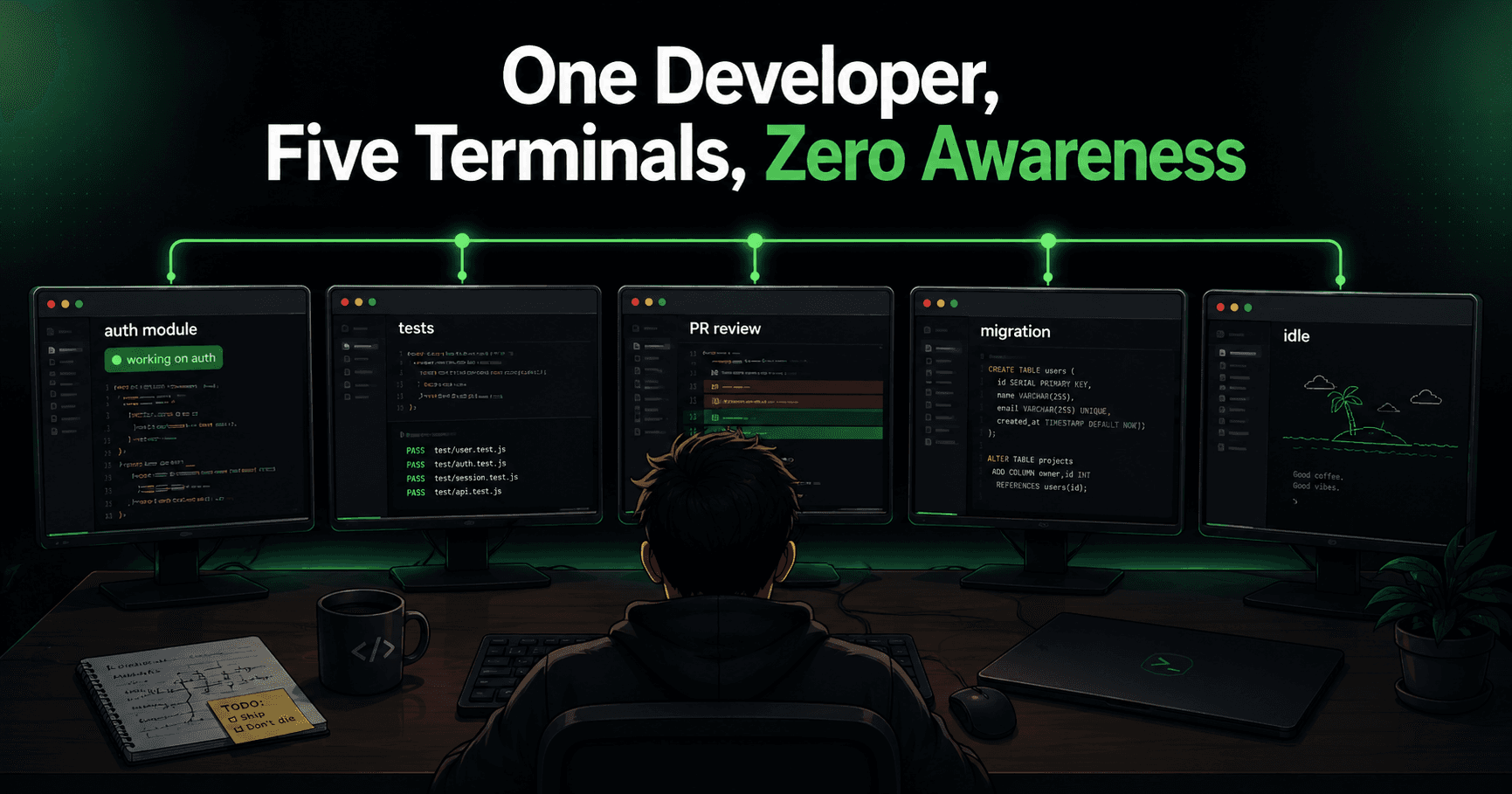
And because it isn't trapped in one tool's config file, it follows you. Claude Code on Monday, Cursor on Tuesday, Copilot for the PR review on Wednesday — same memory, same truth, no three-way drift between three stale files telling three agents three different versions of last month.
That living layer is what I built ContextForge to be: a memory that plugs into Claude Code, Cursor, and Copilot over MCP, holds your corrections and decisions in one place, and surfaces the right one at the right moment instead of handing your agent a month-old photograph and calling it context.
You don't have to use mine. You can roll your own. What you can't do — what I tried to do, on that Friday, and failed — is keep a static file honest by sheer force of will.
What to do this week
Three things, and you can start the first one in the next ten minutes:
- Audit your
CLAUDE.mdfor lies. Open it and read it like a stranger. Every path, every "we use," every convention — is it still true today? Count the ones that aren't. That number is how often your agent has been confidently misled this month. - Split the durable from the decaying. Some things in that file are genuinely stable (the project's purpose, hard constraints). Some are just state that caches the current shape of the code — and state belongs somewhere that updates itself, not in a file you have to babysit.
- Try a memory layer. ContextForge has a free tier that plugs into Claude Code, Cursor, and Copilot via MCP. Five minutes to set up. Your corrections start sticking instead of rotting.
An empty CLAUDE.md admits it doesn't know. A stale one pretends it does — and your agent can't tell the difference.
Stop asking your agent to trust a photograph. Give it something that can actually keep up with you.
Share this article