The Week Two Problem: 60% of AI Agent Failures Are Not the Model's Fault
The Week Two Problem: 60% of AI Agent Failures Are Not the Model's Fault
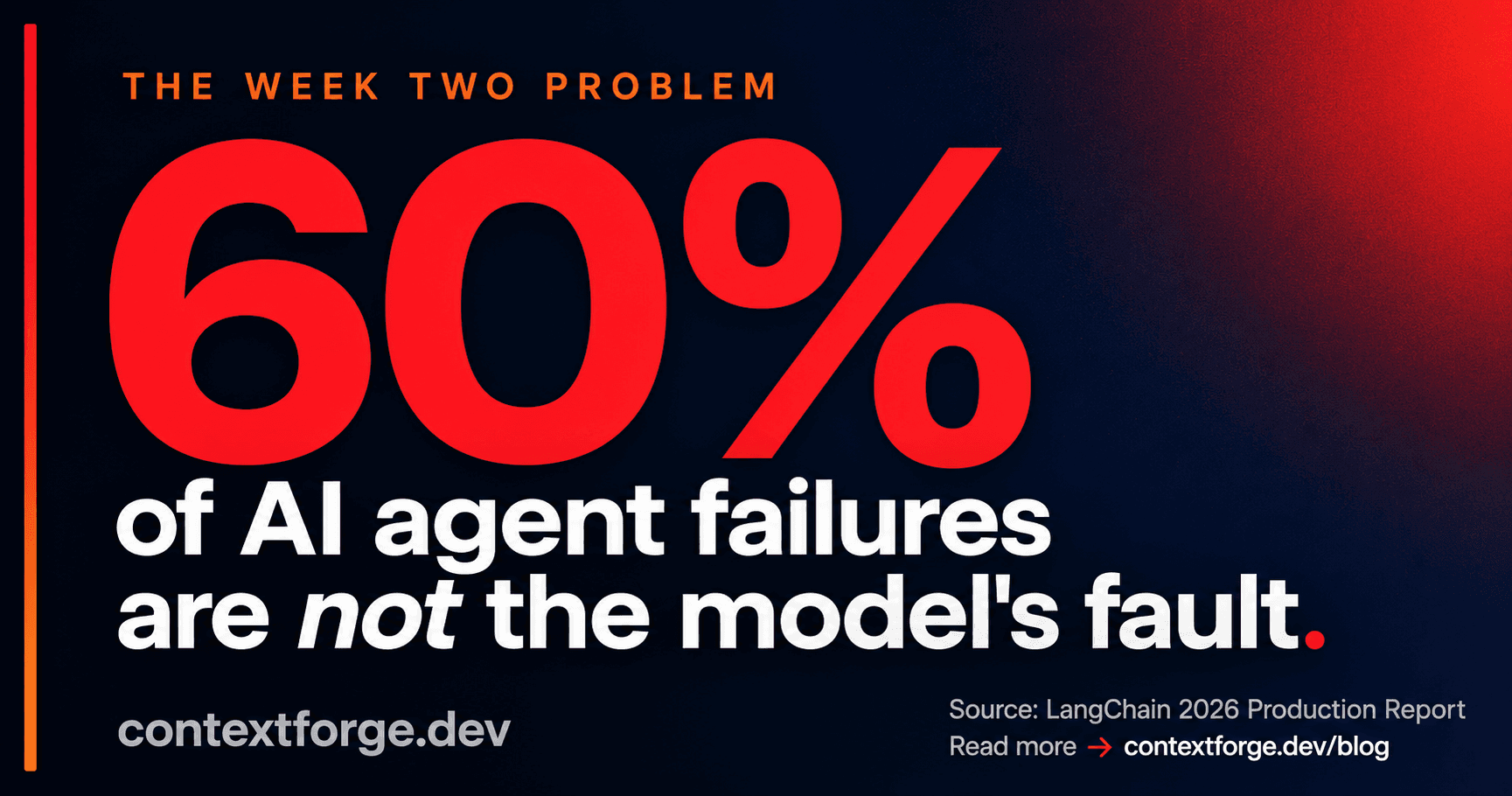
60% of AI agent failures are not from the model.
Read that again. Not from the model. And almost every dev I talk to is still debugging the model — swapping Sonnet for Opus, retuning prompts, comparing Claude Code vs Cursor vs Codex.
LangChain's 2026 production report found that the majority of agent failures trace to the harness, not the LLM. Anthropic's own data shows 71% of Claude's failures come from "consistent wrong interpretation" — the same incorrect assumption, every run.
If you've ever shipped an AI agent, watched it work for a week, then watched it break in week two on something you already fixed — you've lived this. It's not your prompts. It's not the model. Your agent has no memory of what happened on Friday.
The Week Two Problem
There's a pattern that anyone running real AI agents recognizes:
- Demo: flawless. The room claps.
- Week one: holds up. You're a believer.
- Week two: the agent makes the same mistake you corrected on Friday. Then it makes it again on Wednesday. Then on the following Monday.
I started calling this the Week Two Problem because that's when the gap shows up — between "works in a demo" and "actually survives in production." The first week, you're still tuning. The second week, the tuning starts un-tuning itself.
The strange part: nothing changed. Same model. Same prompts. Same tools. The only thing that drifted was the agent's awareness of what already happened.
The Data Nobody's Talking About
I've spent the last month reading every "my agent broke" thread I could find — Reddit, HN, DEV.to. The same three data points keep showing up:
1. LangChain 2026 production report: Around 60% of agent failures trace to the harness, not the model. Cold boots, lost identity across sessions, poor sub-agent briefing — all the things the LLM is not responsible for.
2. Anthropic's own evals: 71% of Claude's failures in production come from "consistent wrong interpretation" — making the same incorrect assumption across every run. If the agent had memory of "we already tried that, here's why it doesn't work," that whole bucket disappears.
3. The 21,000-token typo fix: A Claude Code agent was logged consuming over 21,000 input tokens to make a one-line spelling correction. Why? Because every run re-loads the same context from scratch, including the things the agent already learned and forgot. Reddit practitioners report 70–120x cost spikes on multi-step agents for exactly this reason.
These are not three problems. They are one problem wearing three costumes. The harness doesn't remember.
Why a Bigger Context Window Won't Save You
The instinct, when an agent forgets, is to give it more room to remember. Bigger context window. More tokens. Stuff the whole project into the prompt.
I wrote about why this fails — it's called context rot, and it makes the problem worse, not better. A bigger haystack doesn't help you find the right needle. It just gives the model more wrong needles to confuse the right one with.
If you've been told "the new model has a 2M token context window, so memory is solved," that's the same vendor selling you the same problem with more pages.
Memory ≠ Context
Here's the distinction that matters, and almost no one names it cleanly:
- Context is what your agent sees on this turn. The current prompt, the current tools, the current scrollback. It dies when the session ends.
- Memory is what survives the session. What the agent learned on Tuesday and can recall on Friday. What it tried, what failed, what you corrected, what the constraint actually was.
A bigger context window grows the first thing. It does nothing for the second.
This is why Claude's built-in memory feature, Cursor rules, .cursorrules, and CLAUDE.md files are all half-solutions. They store some memory in some place, often tied to a specific tool. The moment your workflow crosses tools — Claude Code Monday morning, Cursor Tuesday afternoon, Copilot for the PR review — the memory doesn't follow. So you end up with three different agents with three different partial views of the same project, all making the same wrong assumption from earlier this week.
This is the same pattern I described in "Why Your AI Coding Assistant Forgets Everything" — every session starts from zero, no matter how many notes you keep on the side.
That's the Week Two Problem in slow motion.
The Missing Harness
What would a real harness look like?
It would store corrections once. When you tell the agent "don't use that library, it doesn't support our Node version," that constraint persists — across sessions, across tools, across the entire team. The next time any agent on any tool reaches for it, the memory layer says no.
It would recognize patterns across sessions. Not "remember everything verbatim" — that's just context rot in a new bottle. But "remember the decisions and the constraints and the things-that-did-not-work." The model handles reasoning. The harness handles continuity.
It would reduce token spend, not increase it. Because the agent stops re-discovering things it already learned. The 21,000-token typo fix becomes 1,200 tokens because the agent already knows the file's conventions, the recent corrections, the patterns that matter.
This is the layer I built ContextForge for. It's a memory layer that plugs into Claude Code, Cursor, Copilot, and any MCP-compatible client. Corrections in one place. Persistence across sessions. Relationship-aware recall so the right memory surfaces at the right moment, not all of them at once.
It's not the only way to solve this. You can hand-roll a memory layer. You can build your own embedding store. You can chain together vector DBs and tool definitions. What you cannot do — and what nine out of ten teams are still trying to do — is keep debugging the model and expecting the failures to stop.
What to Do This Week
If you've been losing time to week-two failures, three things you can do right now:
- Audit one agent. List every correction you've made in the last 14 days. How many were persisted? How many will you have to make again next week? That number is your harness debt.
- Separate context from memory in your head. Context is the turn. Memory is the relationship. They are not the same thing, and the same tool rarely solves both.
- Try a memory layer. ContextForge has a free tier that plugs into Claude Code, Cursor, and Copilot via MCP. Five minutes to set up. Your agent stops forgetting Friday by Monday.
The Week Two Problem isn't a model problem. It never was.
Stop debugging the model. Start asking what your harness remembers.
Share this article