Claude Now Remembers 5x More — But It Still Forgets You Tomorrow
Last Tuesday I was three hours deep into a refactor. Not the fun kind — the kind where you're untangling years of tech debt and every file you touch reveals two more that need fixing.
But Claude and I were in the zone. We'd mapped out the dependency chain, figured out the migration order, and even caught a subtle race condition that would've blown up in production. It was one of those sessions where you feel like you're pair programming with someone who genuinely gets it.
Then my laptop died.
I plugged it in, reopened Claude, and typed "ok where were we?"
"I'd be happy to help! What are you working on?"
Three hours. Gone. Not because Claude isn't smart enough to remember — but because that's just how conversations work. They end.
So About That 1 Million Token Thing
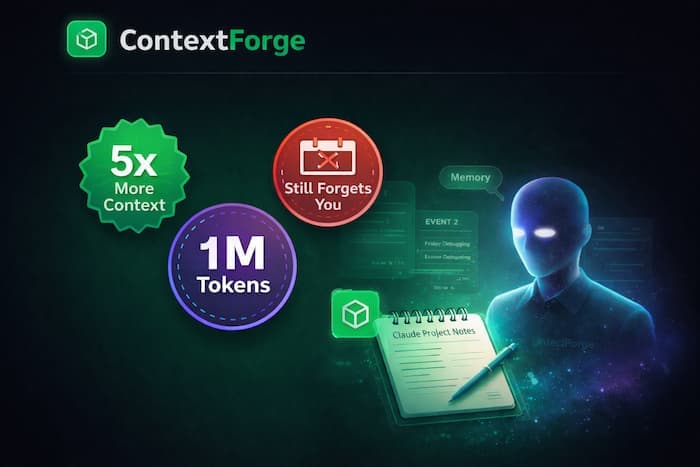
You've probably seen the news. Opus 4.6 now ships with a 1M token context window. Five times bigger than before, same price.
And honestly? It's a massive deal. With a million tokens you can hand Claude your entire codebase and it won't blink. It can hold the frontend, the backend, the tests, the deployment configs, and still have room for a lengthy conversation about all of it.
But I want to tell you about something that happened to me after the announcement. I was scrolling through Twitter and saw someone post:
"1M context window means memory tools are officially dead. Why would you need persistent storage when you can just load everything?"
And I laughed. Not because they're wrong about the power of 1M tokens — they're absolutely right. I laughed because I've heard that exact take every single time context windows got bigger. At 8K. At 100K. At 200K. And every time, three weeks later, those same people are frustrated again.
The Filing Cabinet on Your Desk
Let me tell you why.
Last week a developer on our Discord shared something that stuck with me. He said:
"I upgraded my desk to one of those giant L-shaped ones. I can spread out every document I need. But I still need my filing cabinet because at 6 PM I have to clear the desk."
That's it. That's the whole thing.
A bigger context window is a bigger desk. You can spread out more. You can see more at once. You can make connections between things that used to require flipping back and forth. All of that is genuinely useful.
But when you close the tab — and you will close the tab — the desk gets cleared. Your filing cabinet is what makes Monday morning bearable.
A Wednesday That Changed How I Think About This
Three weeks ago, on a Wednesday, I hit a bug that made no sense. A webhook handler was silently dropping events, but only for one specific customer.
The logs showed nothing. The code looked correct. I was about to start a fresh debugging session when Claude pulled something up from my ContextForge space — a note from January where I'd documented a nearly identical issue.
Turns out, that customer's account had been created during a migration window where a timezone offset was slightly wrong, causing their webhook signatures to validate with a one-second drift.
January. Two months ago. In a conversation I'd completely forgotten about.
I fixed the bug in fifteen minutes. Without that note, I would've burned the afternoon — and maybe part of Thursday — tracing through the same path I'd already walked.
That's not something a bigger context window gives you. That's accumulated knowledge paying dividends over time.
What I Didn't Expect
When I first built ContextForge, I thought of it as a note-taking tool for AI. Save stuff, recall stuff. Simple.
But something unexpected happened once teams started using it.
A developer in São Paulo joined a project that three people had been building for four months. Instead of the usual two-hour onboarding call, she connected to the shared ContextForge space and started asking Claude questions.
"Why did we choose this auth pattern?" "What's the deal with the legacy billing endpoint?" "Are there any known gotchas with the rate limiter?"
Claude answered all of them. Not from documentation — most of it wasn't documented. From the accumulated memory of four months of conversations, decisions, and debugging sessions that the team had been naturally building up.
She shipped her first PR that afternoon.
That's not a feature. That's a side effect of giving AI a way to accumulate knowledge over time. And it has nothing to do with how big the context window is.
Why 1M Actually Makes Memory Better
Here's the part that surprises people: a bigger context window doesn't make persistent memory obsolete. It makes it more powerful.
Before, with a 200K window, ContextForge had to be surgical about what it surfaced. Only the top 5 most relevant memories could fit alongside your code. Tough choices had to be made.
With 1M tokens? Claude can load your recent commits, your architectural decisions, the debugging notes from last month, AND the full code you're working on — all at once. The memory has room to breathe.
Context and memory stop competing for space and start complementing each other. Bigger desk. Same filing cabinet. Better workflow.
The Honest Take
I'm not going to pretend this article isn't partly about ContextForge. It is. I built the thing, I believe in it.
But the honest truth is this: I've watched developers go through the same cycle over and over. A new model drops, context gets bigger, everyone celebrates, and then slowly the frustration creeps back in. Because the underlying problem — that conversations are temporary but projects are not — never actually goes away with a bigger window.
A million tokens is extraordinary. I genuinely mean that. For the first time, you can have a conversation with Claude where it truly understands your entire codebase at once. That changes what's possible in a single session.
But your project isn't a single session. It's hundreds of sessions spread across months. And somewhere between session 47 and session 48, there's a gap where knowledge falls through.
That gap is what persistent memory fills.
ContextForge is free to start. If you've never experienced a Claude that remembers your last conversation, try it once. That's all I ask.
Share this article